
Minimum Grades Must Go
Valuing apathy and ignorance hurts students

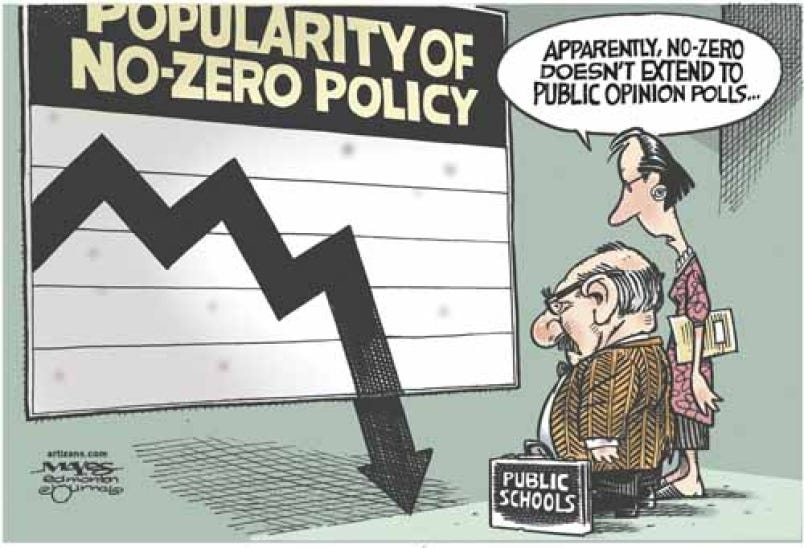
School districts across America have implemented minimum grading, also called no-zero, policies.12 The exact details of these policies vary significantly between school districts, but all share the same fatal flaws.
I have taught students in both middle school and high school environments. Anything stated about schooling without a footnote comes either from my education or my professional experience.
No-zero policies hurt students. These policies encourage apathy and ignorance while discouraging effort and weakening students’ foundations for future schooling.
What is minimum grading?
Minimum grading is the idea that no student should score below some score on any assignment, usually 50%. This idea is mandated as school policy so that no teacher can assign a grade to any student for any assignment which is below the minimum threshold set. This is where the name no-zero comes from: teachers are not allowed to assign zeroes to students for any assignment in districts where these policies are in place.
Teachers can be and have been fired for assigning zeros to students who outright refused to complete or turn in any work.3 Teachers are also discouraged from speaking out against minimum grading policies; opposition to minimum grading is viewed as opposition to helping low-performing students, but it is just the opposite.

Why do no-zero policies exist?
Why would a school district implement a policy like this? While the idea may seem odd on its face, no-zero policies are supposed to address very real issues.
Too much of the grading scale is an F.
Many educators (not me) think that a student who knows 50% of the material does not deserve to fail. This is a reasonable position because there is no objectively correct answer to the question: what percentage of course content should students need to master before advancing to the next grade/class?
Minimum grading alleviates this issue by inflating student grades, so that a student who has only mastered 49% of content could still end up with a significantly higher final grade.
Low grades put students in an academic hole.
Students who regularly perform well can have their grades drastically lowered by just a single bad performance. This is because grading relies on an average (mean), not a median, which means ten assignments where a student scored one zero and nine one-hundreds barely qualify as an A at 90%. An A student would have to get at least 9x as many one-hundreds as zeroes and a B student would need at least 4x as many one-hundreds as zeroes. Clearly, a single zero can seriously hurt a students grade and multiple zeroes can make it impossible for a student to achieve a good grade, even if they ace everything else.
No-zero policies fix this by eliminating zeroes and other low grades; this prevents outliers in student grades and makes their average more consistent and responsive to their recent performance(s).
The only good thing about minimum grading is that it alleviates this issue.
Teachers often view having to re-teach material to a student who has been held back as somewhere between inconvenient and impossible.
Many teachers believe that if a student did not pass the first time, they will not pass the second or third time either. (I resent this view, yet it is widespread.)
We should not base our education policy on what makes teachers most comfortable or their jobs the easiest; education policy should always be based on what is best for students.
Some teachers will say that holding back students is bad for them. This is untrue.
Minimum grading does not affect these issues in a positive way for students. The issues no-zero policies should alleviate are not actually alleviated.
The fatal flaws
Minimum grading policies allow students to get away with cheating and refusing to complete assignments while rewarding students who know less than half (50%) of the content. These policies are a disservice to students, teachers, and school reputations all at once.
Cheating and plagiarism
What should a teacher do if a student cheats or engages in plagiarism?
At the very minimum, the teacher should assign a student a zero (0%) for any assignment where they cheat or plagiarize. Cheating is only unviable for students if it negatively impacts their grades, so allowing cheating students to earn half the amount of points as a literally perfect student makes cheating a viable strategy for students.
We should not be teaching out children that cheating or plagiarism is a viable way to advance in life (because it is not). We should not mislead our students. We should not encourage our students to take the easy way out.
Apathy
While some districts with no-zero policies still allow teachers to assign students zeroes for cheating, few districts with minimum grading policies allow teachers to assign zeroes to students for outright not doing schoolwork.
When a student turns in literally nothing for an assignment or refuses to make any attempt whatsoever, they still get half-credit. When a student tries their hardest but only completes half the requirements, they get half-credit. This effectively punishes the student who tried their hardest but only completed half of the requirements, because they will get the same grade as a student who refused to make any attempt whatsoever.
Even advocates of these no-zero policies acknowledge that we should not be encouraging students to take the easy way out by not completing assignments.4 Somehow, these teachers do not realize that giving points for taking the easy way out only makes the easy way out more appealing.
Ignorance
Obviously, the students ‘helped’ most by minimum grading policies are those who normally score below the minimum grade. Students who typically fail are the ones ‘helped’ most by minimum grades.
I put ‘helped’ in air quotes because passing a student to the next grade - when that student lacks basic understanding of content - is the opposite of help. When a 9th grade student cannot complete tasks at even an 8th grade level, their academic performance will be worse than their peers who can perform at at least an 8th grade level (which should be practically every student in a 9th grade class).
Students who do not know or have not mastered the required content are the students who actually see any benefit from minimum grading. Those students who always score above the minimum grade are never benefitted in any way by no-zero policies. These policies only help students who either cannot or will not meet standards.
[S]tudents who always score above the minimum grade are never benefitted in any way by no-zero policies.
Punishes students who try
Many students typically earn Ds and Cs on their report cards; these students see no benefit from a minimum grading policy. The only way these students see any benefit is by inflating the grades of students who made an attempt, but this discourages A students from trying their best because high grades can only be inflated so much before the 100-point scale is broken.
Rewarding students who give 0% effort with a grade of 50% or rewarding students who give 60% effort a grade of 75% tells students that they can reduce their effort while receiving the same or better grades.
Under minimum grading polices, students who score 100% receive nothing extra. Students who score 0% receive an extra reward of 50%. If you saw your peers who put in literally 100% less effort than you receiving literally half of the rewards as you, would you keep giving your 100%?
[no-zero policies tell] students that they can reduce their effort while receiving the same or better grades.
Pushing students through
Advocates of no-zero policies say they encourage students to learn and “move to the next step.”5 Somehow, these teachers do not realize that passing a student who has failed to demonstrate a passing level of content knowledge only puts them at a disadvantage once they are advanced to the next grade level.
Teachers should tell students that “failure… is not an option.”6 This can only be true when students who fail are held back. When students who fail (i.e., students who demonstrate less than 60% of the required content knowledge) are passed to the next grade level or class, failure has become an option. Nothing says failure is acceptable quite like ‘failure will have literally no immediate negative ramifications in your life.’
What is the solution?
First of all, get involved with your local schoolboard because they are the only ones who can decide these things.
But what should you advocate for instead?
A 20-point grading scale
Here’s what I believe to be a much better idea that achieves similar goals:
A 50% minimum grade effectively creates a 50-100 grading scale, thus each letter grade takes up an equal part of the grading scale (except for A, which gets one more point in its range). 50-59 as F, 60-69 as D, 70-79 as C, 80-89 as B, and 90-100 as A.
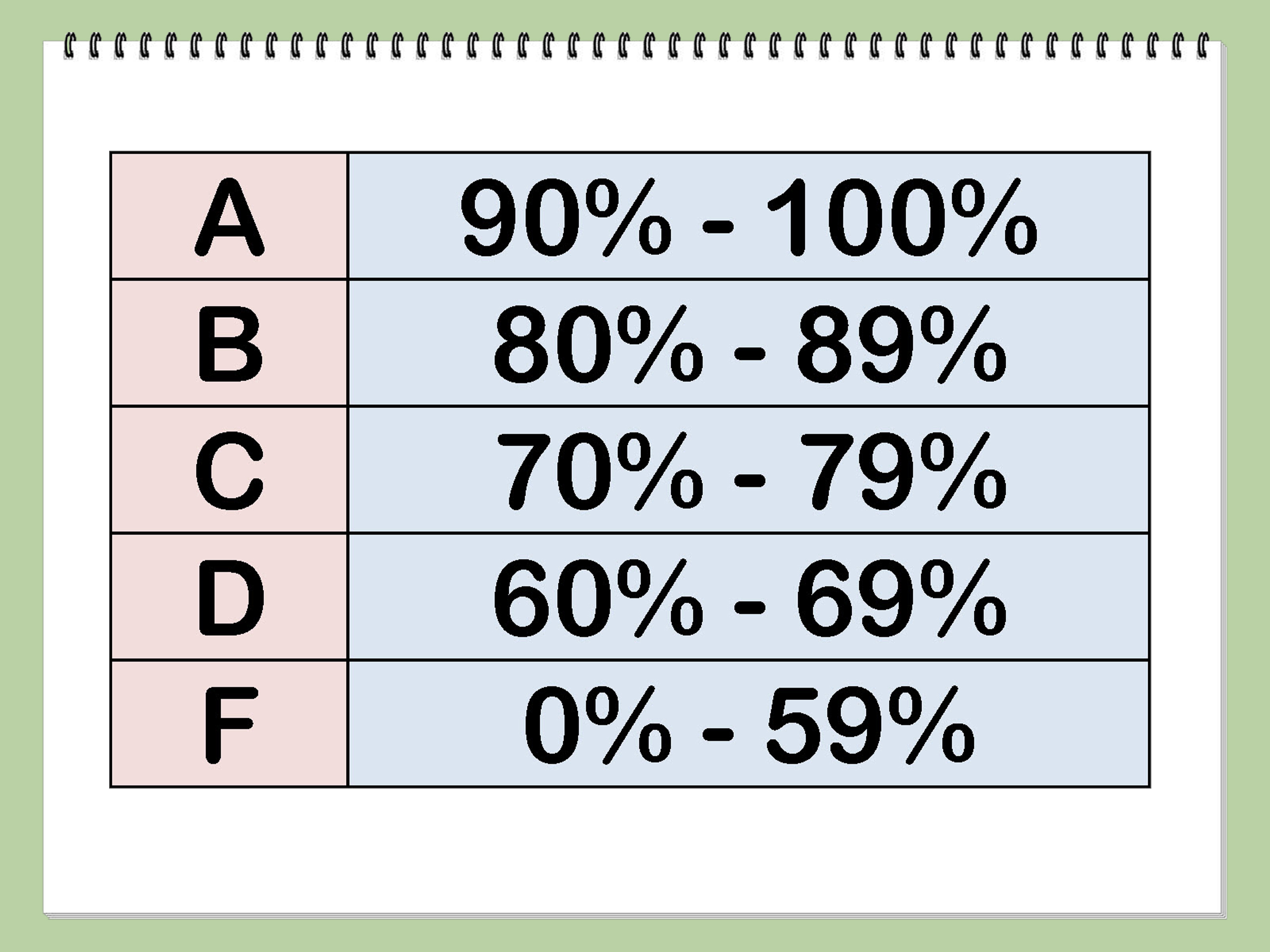
To achieve the goal of each letter grade taking up an equal part of the grading scale, advocates of a no-zero policy should instead advocate for a 20-point grading scale. This would simultaneously mean each letter grade represented an equal amount of the grading scale and allow teachers to assign students zeros without putting students into an academic hole they cannot dig out of.
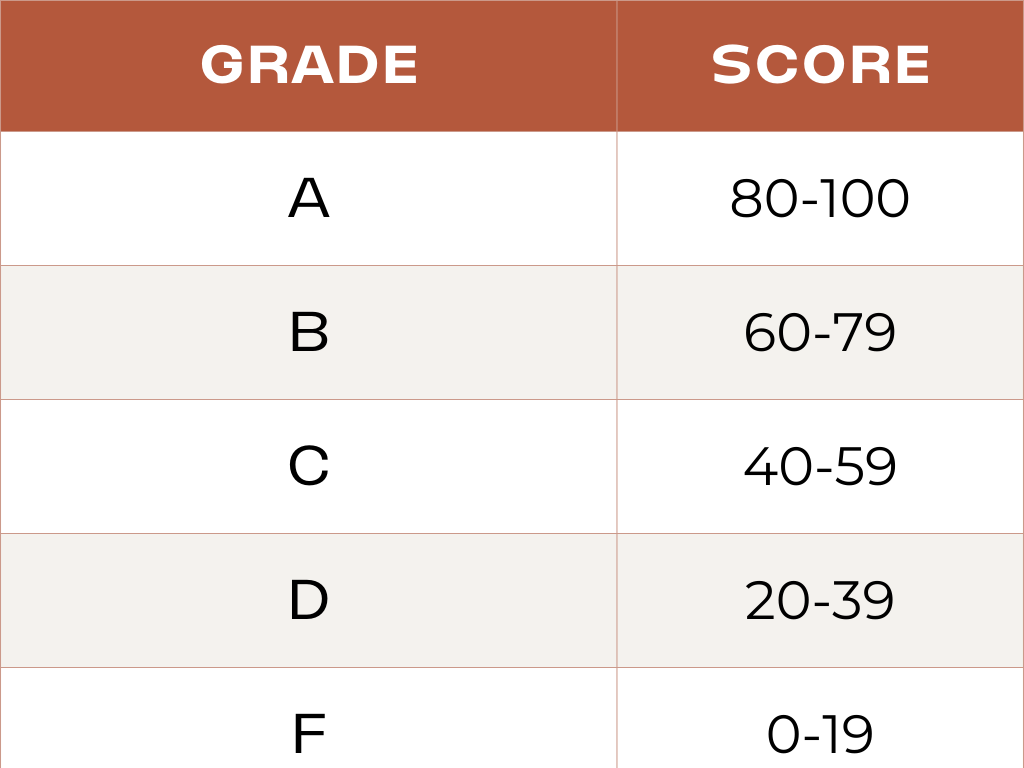
This is not an idea that I am a huge fan of, but it does a much better job of addressing the issues that pro-minimum grading advocates say they want to fix than no-zero policies.
A consistent late work, retake, and make-up policy
Zeroes can put students into an academic hole that they cannot get out of, yes. To fix this, school districts should implement consistent late work and retakes policies.
If a zero can be overwritten by retaking a test or completing a missing assignment, then a student with many zeroes has a clear path towards digging themselves out of an academic hole.
Depending on how it is implemented, I would favor district-wide late work and/or retake policies.
Teach
Getting a student who failed one year to pass the next year is very possible. Getting a student who failed one quarter to pass for the year is very possible. Depending on the student, this could be an easy task or an extraordinarily difficult task, but it is always possible, so long as the student is not years behind on their prior knowledge from being passed to the next grade without mastering required content.
Instead of not letting a student fall into an academic hole, teachers should help students get out of the holes they get themselves into.
So What?
I have worked in a district that used minimum grading policies and I saw that minimum grading exclusively served to push students through the education system when they desperately needed to be held back and told: you failed, try again. Minimum grading does a poor job of fixing the problems which its advocates want fixed.
Minimum grading policies do not help any student, even those who typically fail. Helping a student who is failing means helping them get up to where they need to be. Lowering standards for students who cannot meet them is the opposite of helping students and antithetical to education.
Too many students are already graduating with a high school diploma. Pushing more students through school who do not deserve a diploma only worsens this issue.
Get involved wherever you can. Make sure schoolboards know: pushing students away from academic excellence is an unacceptable and irresponsible thing for schools to do. Any person who advocates for minimum grading policies is not someone I would trust to educate my own or anyone else’s children.
As they exist, no-zero policies prevent a teacher from having bad feelings about holding a student back, even when that is what would be best for the student. I just wish that educators who advocated nonsense like no-zero policies lived up to their word and started “do[ing] what’s best for children, period.”7
Just wanted to hop in and say that, while I don't agree with much philosophically here, I think it does a really nice job articulating some of the arguments for minimum grade policies—which I think a lot of pieces in edu-discourse fail to do, instead taking all-or-nothing argument tactics.
I'd also offer, from my personal experience, that some reasonable "half measures" have been effective for our classroom of late. For example, we have offered minimum grades (but only 25%) on missing classwork (which is not worth much) but not on assessments, requiring students to revise or retake assessment scores that have the most weight for their overall grade. The goal is to avoid a pile of missing classwork to keep a student from passing and instead focus on them taking and improving their assessment scores, and this feels like it has served students reasonably well so far in our context!
More importantly, just wanted to say that I appreciate the thoughtfulness across this post—and hoping to see more posts like this in the future!
Thank you for reading and sharing your thoughts!
I want to convince people who advocate for minimum grading, and the only way to do that is to acknowledge and then address their concerns. I believe those advocates do want what's best for students, and we just have real disagreements about how to achieve that.
Your district's minimum grading policy sounds much better than mine, where students cannot receive below a 50% on any assignment for any reason. My opposition to these policies would be much weaker if they weren't so unreasonable in some districts, like mine.
What do you do if a student does their best and scores a 20%? Do they get the same score of 25% as a student who didn't even come to class? If they get their 20% plus the minimum 25% to score a 45%, then what do students scoring >75% get? My opposition to minimum grading comes mostly from my inability to come up with good answers to these questions; I'm not even convinced there are good answers to those questions.